hero background
Infrastructure Rehabilitation

Pile Load Testing — Deep Foundation Verification & Quality Assurance

Pile load testing verifies the load-bearing capacity of deep foundation elements to ensure structural performance and safety. EFT performs ASTM-governed load tests for both new and existing piles — providing critical data on actual capacity, construction quality, and foundation reliability for commercial, industrial, and infrastructure projects.

What Is Pile Load Testing?

Pile load testing is an engineered procedure used to confirm the actual load capacity of a foundation pile before or after installation. This process is essential for deep foundations — including driven piles, helical piers, and cast-in-place elements — to validate design assumptions and support long-term structural performance.

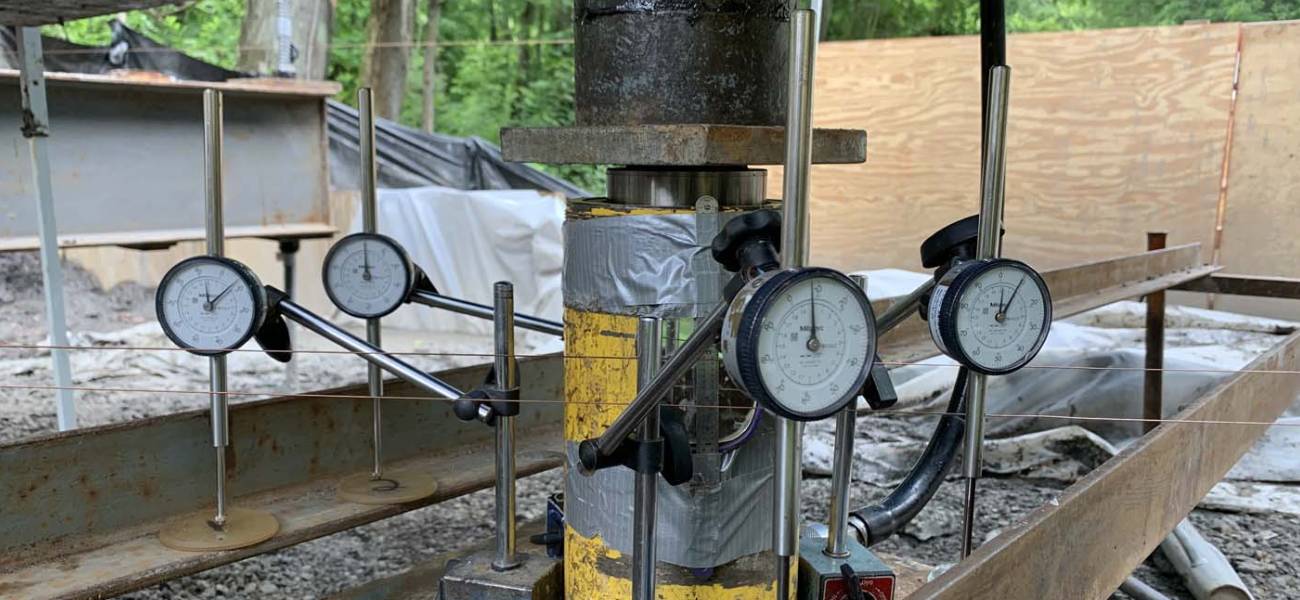
During a load test, a calibrated hydraulic jack applies incremental load to a pile while an engineered reaction frame resists the force. Measurements are taken at each stage to develop a load-settlement curve, which a qualified engineer interprets to determine real-world capacity and structural behavior. Testing procedures are governed by applicable ASTM standards, ensuring reliable results and compliance with engineering specifications.
Why Load Testing Matters

Verification of actual pile capacity reduces risk, ensures construction quality, and provides confidence for engineers, owners, and project stakeholders — especially on critical infrastructure, high-occupancy structures, and heavy load conditions.

Challenges That Require Pile Load Testing

Uncertain Foundation Capacity

Design calculations predict capacity, but variations in soil, installation method, and installation quality can affect real performance. Load testing confirms actual behavior under load.

Risk of Settlement or Structural Failure

Without verification, unsupported assumptions about soil conditions can lead to excessive settlement, uneven loading, or performance issues in service.

Regulatory and Project Compliance

Many projects require documented capacity verification per building codes, ASTM standards, or engineering specifications — especially for critical infrastructure and commercial developments.

Key Advantages of Professional Pile Load Testing

Accurate Capacity Verification

Pile load tests provide empirical data on the pile’s true load-bearing capability, ensuring foundation performance meets engineering design and safety requirements.

Compliance With Engineering Standards

Testing follows recognized ASTM protocols (e.g., ASTM D1143 for axial compression, D4945 for integrity) — giving clients confidence in quality assurance and contract compliance.

Risk Mitigation and Confidence

Identifying performance trends and load behavior early reduces the risk of future foundation issues, costly remedial work, or service failures.

Improved Design Feedback

Load-settlement curves and test results help engineers refine designs, adjust structural considerations, and make informed decisions based on measured performance.